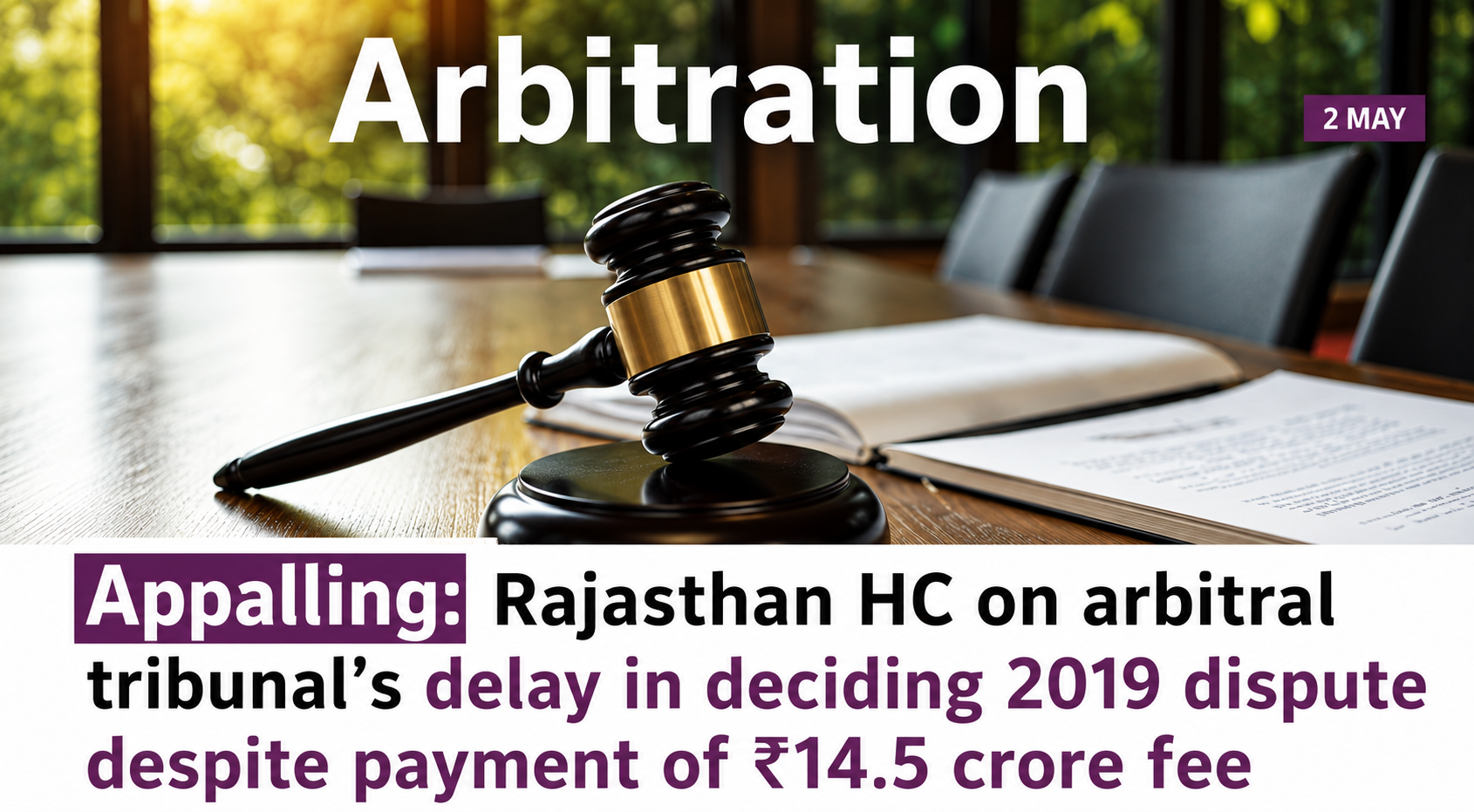
Rajasthan High Court Takes Serious View of Arbitral Tribunal’s Failure to Conclude Proceedings | Kartik Seth Represents State Power Companies
In a significant development that once again brings the systemic dysfunction of ad hoc arbitration under judicial scrutiny, the Rajasthan High Court has expressed grave concern over an arbitral tribunal’s failure to conclude proceedings in a long-pending dispute between three State power companies and HCL Infosystems Limited — a matter that has dragged on since 2019. Advocates Kartik Seth and Shilpa Saini appeared for the State power companies, placing the Court in a position to confront what has become an increasingly urgent question in Indian arbitration: when does delay become a denial of justice?
The Case at a Glance
The arbitration in question involves three Rajasthan State power companies on one side and HCL Infosystems Limited on the other. The dispute has been pending before an arbitral tribunal of considerable stature — comprising a former Supreme Court judge and two retired High Court judges. Despite the seniority and experience of the tribunal, proceedings have remained inconclusive since 2019. What has made this matter especially striking is the financial cost borne by the parties in the interim: the Court was informed that the parties have together paid approximately ₹14.5 crores in arbitration fees — a staggering sum that continues to grow with each passing session and each successive adjournment.
The Court’s Serious View
The Rajasthan High Court did not mince words. Taking a serious view of the tribunal’s failure to bring proceedings to a conclusion, the Court’s intervention signals a broader judicial impatience with the culture of delay that has taken root in ad hoc arbitration in India. When a tribunal of this composition — one that commands the highest daily fees precisely because of the expertise and efficiency it is presumed to bring — is unable to conclude a dispute after years of proceedings, the very premise of arbitration as a faster and more efficient alternative to court litigation is called into question. The Court’s intervention in this matter is therefore not merely about one dispute — it is a statement about the standards that arbitral tribunals must be held to.
₹14.5 Crores and Counting: The Cost of Delay
The financial dimension of this matter deserves particular attention. At approximately ₹14.5 crores in arbitration fees already paid — and with the underlying dispute involving State power companies that ultimately serve the public interest — the cost of this delay is not abstract. It is a direct burden on public resources. Kartik Seth’s representation of the State power companies placed this reality squarely before the Court, ensuring that the financial and institutional stakes were clearly articulated and that the Court had the full picture of what prolonged, inconclusive arbitration truly costs. This is precisely the kind of systemic advocacy — going beyond the narrow legal question to illuminate the broader consequences — that defines effective public sector legal representation.
Kartik Seth’s Role
Appearing alongside Advocate Shilpa Saini for the three State power companies, Kartik Seth brought to this matter his well-established expertise in energy sector disputes and his familiarity with the Rajasthan High Court’s evolving jurisprudence on arbitration oversight. This is not the first time Kartik Seth has appeared before the Rajasthan High Court in matters concerning arbitration delays and escalating costs in disputes involving State power entities — and his consistent presence in such matters reflects a deep and specialised understanding of both the legal issues at stake and the institutional dynamics at play. His ability to present the State’s concerns effectively and to invite the Court’s supervisory intervention demonstrates the kind of strategic legal thinking that complex public sector disputes demand.
A Continuing Pattern: Judicial Scrutiny of Arbitration Costs
This matter is part of a broader pattern of judicial concern that has been building around ad hoc arbitration in India — particularly in high-value disputes involving public sector entities. Courts across the country have increasingly been called upon to examine whether arbitral tribunals are discharging their mandate with the efficiency and cost-consciousness that the law and the parties’ expectations demand. The Rajasthan High Court’s intervention in this case adds an important chapter to that growing body of judicial scrutiny and sends a clear message to arbitral tribunals: delay and spiralling costs will not go unexamined, and judicial oversight remains an active and available check on arbitral excess.
Why This Matter Is Significant
Beyond its immediate facts, this case raises fundamental questions about the design and accountability of ad hoc arbitration in India. When disputes involving public resources drag on for years before high-fee tribunals, the question is not merely legal — it is one of governance, public accountability, and institutional integrity. Kartik Seth’s representation of the State power companies in bringing this matter to the Court’s attention reflects his commitment to not just winning arguments, but to advancing the broader cause of a functional, fair, and cost-effective dispute resolution system.