PM-KUSUM: Turning Subsidy into Sustainable Rural Energy Capital
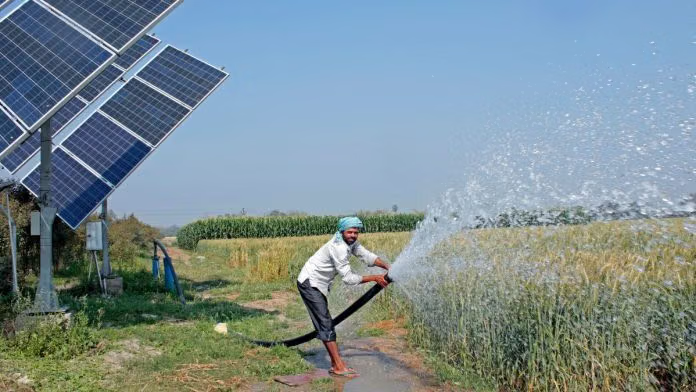
In a column published in ThePrint, Kartik Seth examined the Pradhan Mantri Kisan Urja Suraksha evam Utthaan Mahabhiyaan (PM-KUSUM) scheme, arguing that it is far more than an election-season subsidy — it is a structured investment in rural energy capital. Unlike typical welfare schemes that end once funds are disbursed, PM-KUSUM begins there, converting public support into tangible assets: solar pumps and decentralised power plants that reduce farmers’ energy costs, generate income, and add clean power close to where it is needed most.
Why Distributed Power Matters Now
Drawing on Central Electricity Authority projections showing peak power demand rising sharply by 2031-32, Kartik Seth highlighted why decentralised, agriculture-linked solar generation has become critical to India’s energy security. He explained the scheme’s architecture across its three components — decentralised plants, standalone irrigation pumps, and feeder-level solarisation — noting that farmers with solarised grid-connected pumps can use the power for irrigation while selling surplus electricity to distribution companies, creating a direct link between farming and energy production.
Rajasthan as a Model of Institutional Continuity
A central theme of the column, shaped by Kartik Seth’s extensive first-hand experience working with Rajasthan’s electricity sector, was the state’s standout performance under PM-KUSUM — commissioning over 70% of the country’s Component A capacity. He attributed this success not merely to geography or sunlight availability, but to sustained institutional continuity across successive leadership — from the late Shri Alok Ji, to Ajitabh Sharma, IAS, and now under the current Secretary to Government, Energy Department, Arti Dogra. Kartik Seth emphasised that durable policy outcomes are built when institutions preserve momentum across changing administrations, rather than resetting with each new government.
Capital, Not a Freebie
Kartik Seth detailed the scheme’s financing structure — combining central assistance, state subsidy, farmer contribution, and bank finance — to argue that PM-KUSUM creates lasting productive assets rather than one-time relief. He cautioned, however, that success depends on credible feed-in tariffs, bankable power-purchase agreements, accurate metering, and timely payments, given that Component A’s contracts run for 25 years, far beyond any single electoral cycle.
Scaling Responsibly, With Safeguards
The column also addressed implementation challenges flagged in parliamentary replies — including financing access, land availability, and technical bottlenecks — while underscoring the importance of agricultural and water safeguards. Kartik Seth noted that solar income must supplement farming, not replace it, and that priority must continue to be given to small and marginal farmers using micro-irrigation.
The Larger Vision: Annadata to Urjadata
Concluding the piece, Kartik Seth framed PM-KUSUM as part of a broader economic transition — enabling India’s farmers to move from being only annadata (food-providers) to also becoming urjadata (energy-providers). The column was published with a note of thanks to ThePrint and senior journalist Shekhar Gupta for carrying the piece.