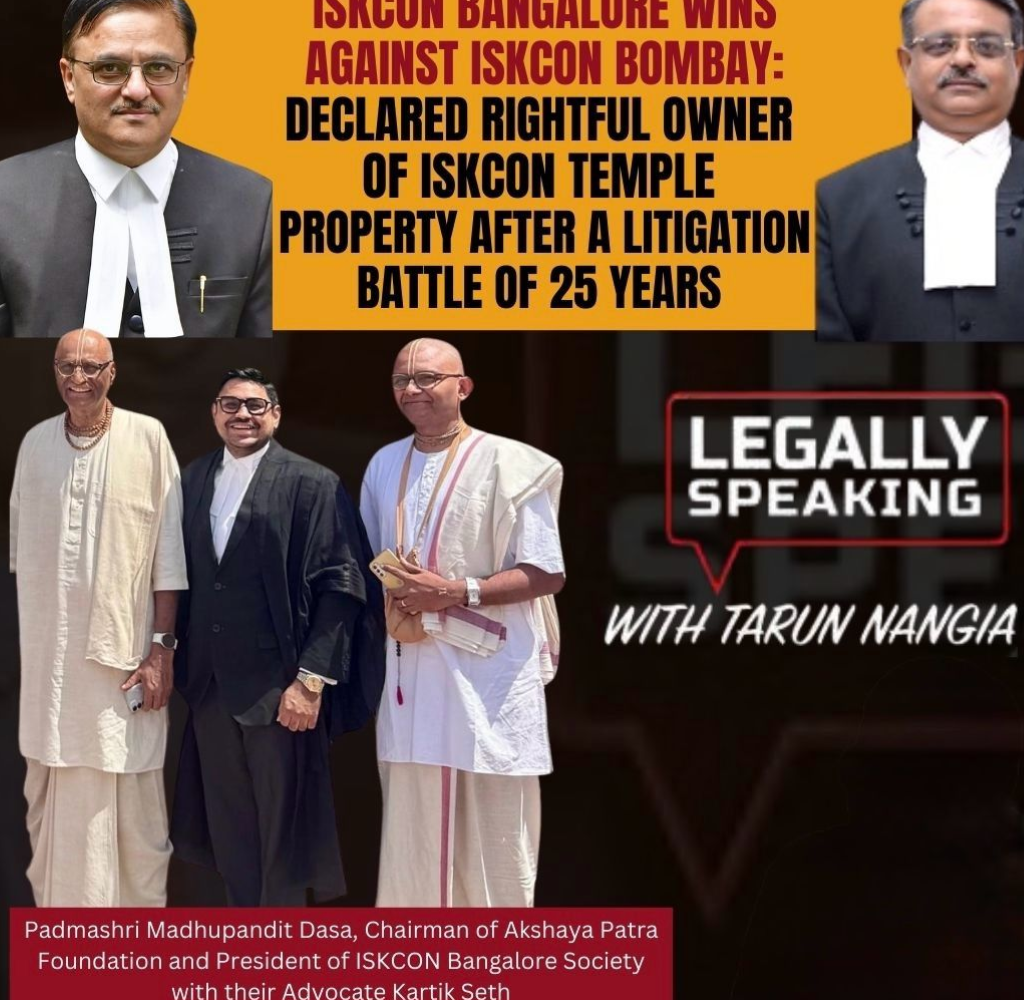
In a landmark judgment bringing closure to one of the longest-running institutional disputes in India’s religious and organizational landscape, the Supreme Court of India has declared ISKCON Bangalore as the rightful owner of the iconic ISKCON temple property in Bengaluru. The decision concludes a protracted legal battle spanning over 25 years between ISKCON Bangalore and ISKCON Mumbai, with wide-ranging implications for governance, property rights, and institutional autonomy within religious organizations.
The ruling marks a decisive moment in a dispute that has not only drawn legal scrutiny but also attracted national attention due to the prominence of the institutions involved and the scale of their social and spiritual activities.
The conflict between ISKCON Bangalore and ISKCON Mumbai traces its roots back to differences over administrative control and ownership of the Bengaluru temple property. While both entities are part of the global International Society for Krishna Consciousness movement, their organizational structures and governance models have evolved differently over time.
At the heart of the dispute was the question of whether ISKCON Bangalore functioned as an independent legal entity with ownership rights over the temple property, or whether it operated under the administrative control of ISKCON Mumbai, which claimed overarching authority.
Over the years, the matter moved through various legal forums, including trial courts and High Courts, before finally reaching the Supreme Court. The prolonged litigation reflected the complexity of the issues involved, ranging from trust law and property rights to questions of religious governance and institutional identity.
In its final judgment, the Supreme Court upheld the position of ISKCON Bangalore, recognizing it as the legitimate owner and administrator of the temple property. The Court’s decision effectively settles the question of control, affirming that ISKCON Bangalore operates as an independent entity with full legal rights over its assets.
The ruling is significant not only for resolving the immediate dispute but also for setting a precedent in similar cases involving religious and charitable organizations. By emphasizing legal ownership and institutional autonomy, the Court has reinforced the importance of clearly defined governance structures.
A key figure in the litigation was Madhupandit Dasa, President of ISKCON Bangalore Society and Chairman of the Akshaya Patra Foundation. A recipient of the Padma Shri, Madhupandit Dasa played a central role in guiding the institution through the prolonged legal process.
Under his leadership, ISKCON Bangalore not only pursued its legal claim but also continued to expand its social initiatives, including large-scale mid-day meal programs through the Akshaya Patra Foundation. His stewardship ensured that the institution remained focused on its spiritual and social mission even as the legal battle unfolded.
Legal representatives involved in the case described the opportunity to assist ISKCON Bangalore before the Supreme Court as both an honour and a professional milestone, given the case’s complexity and historical importance.
The judgment carries broader implications for religious and charitable organizations across India. It underscores the necessity of clear legal documentation, transparent governance, and well-defined institutional structures to avoid disputes of this nature.
In many cases, religious organizations operate through a network of societies, trusts, and affiliated entities. The lack of clarity in their legal relationships can lead to conflicts over control and ownership. The Supreme Court’s ruling highlights the importance of establishing legal independence and accountability within such frameworks.
From a legal perspective, the decision contributes to greater certainty in matters involving property rights and institutional governance. By resolving a dispute that persisted for over two decades, the Court has demonstrated the role of the judiciary in providing finality and stability in complex cases.
Legal experts note that the ruling may serve as a reference point for future disputes involving similar questions of autonomy and control. It also reinforces the principle that long-standing possession and operational independence, when supported by legal evidence, can play a crucial role in determining ownership.
Beyond its legal implications, the judgment holds cultural and social significance. The ISKCON temple in Bengaluru is not only a place of worship but also a major cultural landmark, attracting thousands of devotees and visitors each year.
The resolution of the dispute ensures continuity in the temple’s operations and its associated activities, including educational and charitable initiatives. For devotees and stakeholders, the decision brings clarity and stability, allowing the institution to focus on its core mission.
The 25-year duration of the case also serves as a reminder of the challenges associated with prolonged litigation in India. While the eventual resolution is decisive, the time taken underscores the need for more efficient dispute resolution mechanisms, particularly in cases involving public interest and institutional governance.
Efforts to streamline judicial processes and promote alternative dispute resolution mechanisms could help reduce the burden of such long-running cases in the future.
The Supreme Court’s ruling in favour of ISKCON Bangalore marks the end of a historic legal battle and sets a clear precedent for institutional autonomy and property rights within religious organizations. By affirming the independence and ownership of ISKCON Bangalore, the Court has provided much-needed clarity in a complex and long-standing dispute.
As the institution moves forward, the judgment is expected to strengthen its governance framework and enable it to expand its spiritual and social initiatives with renewed confidence. For the broader legal and religious landscape, the case stands as a significant milestone, illustrating the critical role of law in resolving complex institutional conflicts and ensuring stability.
Stay updated with the latest legal news, tips, and Justiq announcements.

Chambers of Kartik Seth — Supreme Court Registered Firm. Practising before the Supreme Court, Delhi High Court, and High Courts across India for nearly fifteen years.
Copyright © Chambers of Kartik Seth. Powered By Readycoder Ventures Pvt. Ltd.
The Bar Council of India prohibits advocates from engaging in any form of advertisement or solicitation. By accessing the Chambers of Kartik Seth website (our website), the user acknowledges that:
Agree and Enter Decline