In a significant development for arbitration jurisprudence in India, the Supreme Court of India has clarified the legal position on arbitrator fees in light of the 2019 amendments to the Arbitration and Conciliation Act, 1996. The ruling addresses long-standing ambiguities surrounding whether statutory fee schedules are binding or merely indicative when parties have contractually agreed upon a fee structure.
The decision is expected to have far-reaching implications for arbitration proceedings, particularly in high-value commercial disputes where arbitrator fees often become a point of contention.
Background: The Dispute Over Arbitrator Fees
The issue came into focus in the case of National Highways Authority of India v. Gayatri Jhansi Roadways Limited, where questions arose regarding the applicability of the Fourth Schedule of the Act, which prescribes a model fee structure for arbitrators.
Historically, courts and tribunals have grappled with whether this schedule is mandatory or merely a guideline. This uncertainty often led to disputes between parties and arbitrators, sometimes delaying proceedings and increasing litigation costs.
The matter gained further complexity after the 2019 amendment, which aimed to institutionalize arbitration and bring greater transparency to the fee regime.
The Legal Question: Mandatory or Directory?
At the heart of the dispute was a fundamental legal question — does the Fourth Schedule of the Arbitration and Conciliation Act bind parties and arbitrators, or can parties contractually agree to a different fee structure?
One school of thought argued that the statutory schedule should prevail to ensure uniformity and prevent excessive fees. Another emphasized the principle of party autonomy, a cornerstone of arbitration, which allows parties to define the terms of their dispute resolution mechanism.
This divergence necessitated authoritative clarification from the Supreme Court.
The Supreme Court’s Ruling
The Supreme Court decisively settled the issue by holding that the Fourth Schedule is not mandatory in cases where parties have already agreed upon a fee structure in their arbitration agreement.
In doing so, the Court reinforced the principle of party autonomy, recognizing that arbitration is fundamentally a consensual process. Where parties have exercised their freedom to determine arbitrator fees, such agreements must be respected.
The Court also overruled the contrary view taken by the Delhi High Court, thereby bringing much-needed clarity and consistency to the legal position.
Key Observations by the Court
The Court emphasized several critical points in its judgment:
- The Fourth Schedule serves as a guiding framework rather than a binding rule.
- Party autonomy remains central to arbitration proceedings.
- Judicial interference in agreed fee structures should be minimal, except in exceptional circumstances.
By articulating these principles, the Court has provided a clear roadmap for both arbitrators and litigants.
Role of Legal Experts and Authors
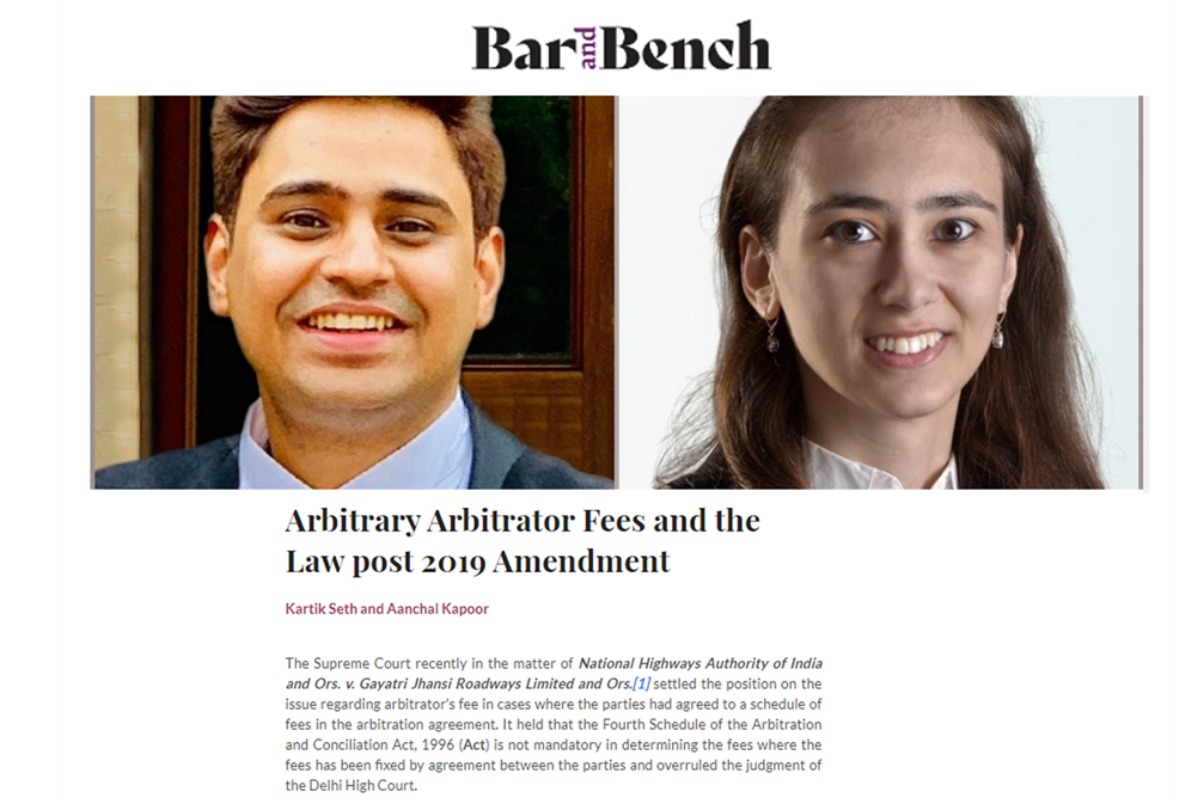
The issue has also been examined in detail by legal professionals including Kartik Seth and Aanchal Kapoor, who have analyzed the implications of the judgment in the evolving arbitration landscape.
Their insights highlight how the ruling aligns with global best practices, where party autonomy is given primacy and statutory frameworks act as facilitators rather than constraints.
Impact on Arbitration Practice in India
The judgment is expected to streamline arbitration proceedings by reducing disputes over arbitrator fees. It provides clarity to:
- Parties, who can now confidently negotiate and agree upon fee structures without fear of later judicial modification.
- Arbitrators, who gain certainty regarding their remuneration.
- Courts, which can avoid unnecessary intervention in fee-related disputes.
Additionally, the decision strengthens India’s position as an arbitration-friendly jurisdiction, a key objective of recent legislative reforms.
Balancing Autonomy and Regulation
While the ruling prioritizes party autonomy, it does not completely eliminate the relevance of the Fourth Schedule. In cases where no fee agreement exists, the schedule continues to serve as a useful benchmark.
This balanced approach ensures that:
- Parties retain freedom where they have exercised it.
- A fair framework exists where they have not.
Such a dual structure enhances both flexibility and predictability in arbitration.
Conclusion: A Step Towards a Mature Arbitration Ecosystem
The Supreme Court’s clarification marks an important step in the evolution of arbitration law in India. By reaffirming the primacy of party autonomy while preserving the utility of statutory guidelines, the Court has struck a pragmatic balance.
As arbitration continues to grow as a preferred mode of dispute resolution, such judgments play a crucial role in building confidence among stakeholders — both domestic and international.
Ultimately, the ruling sends a clear message: arbitration in India is not only governed by law but also by the agreements and intentions of the parties themselves.