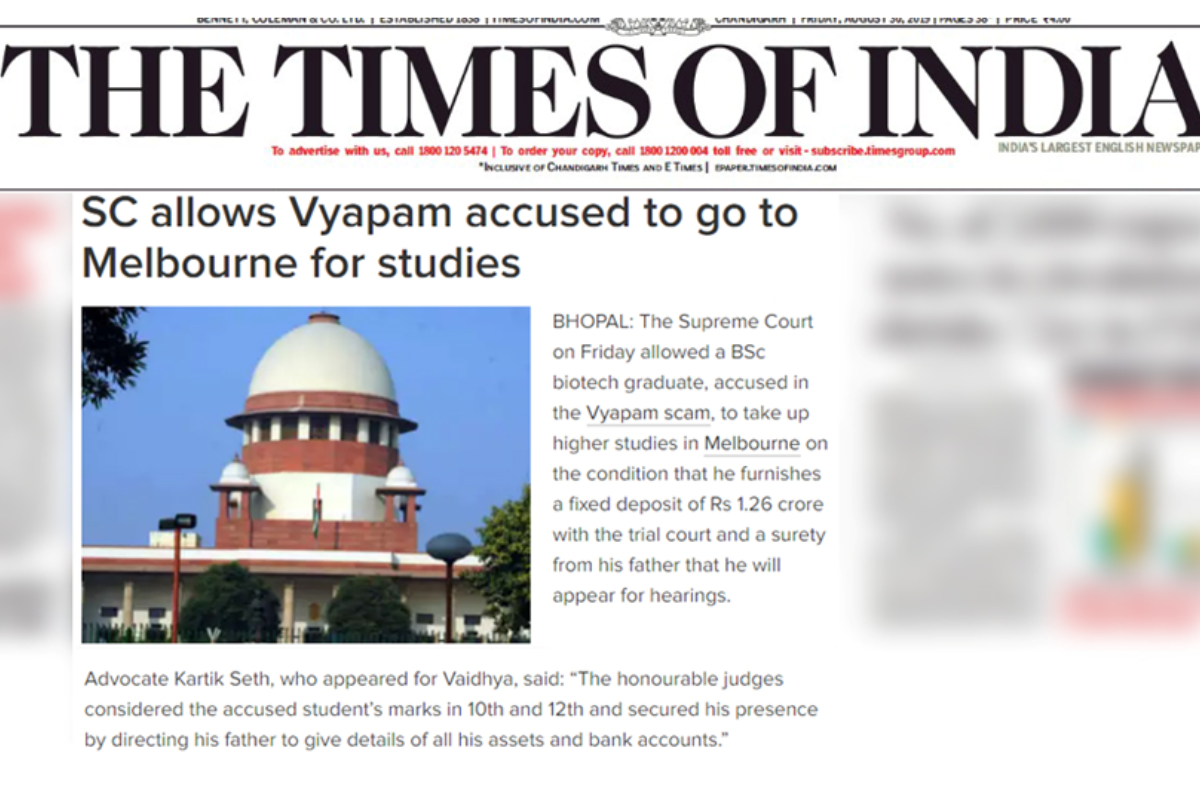
In a noteworthy development, the Supreme Court of India allowed an आरोपी in the widely discussed Vyapam Scam to travel abroad for higher education. The decision reflects the Court’s nuanced approach in balancing an individual’s right to education and personal growth with the need to ensure accountability within the criminal justice system.
The ruling underscores a progressive judicial outlook — one that does not automatically restrict opportunities for accused individuals, while simultaneously safeguarding the interests of justice.
Background: The Vyapam Scam Context
The Vyapam scam, one of India’s most high-profile examination and recruitment scandals, has involved allegations of irregularities in admissions and recruitment processes in the state of Madhya Pradesh. Over the years, numerous individuals have been investigated and prosecuted in connection with the case.
Against this backdrop, requests for relief by accused persons are often viewed with heightened scrutiny. Courts are typically cautious in granting permissions that may risk the accused evading trial or undermining the legal process.
It is within this sensitive and complex environment that the present matter was considered.
The Plea Before the Court
The accused, a BSc biotechnology graduate, approached the Supreme Court seeking permission to travel to Melbourne for pursuing higher studies. The plea raised important questions — should an individual facing criminal charges be allowed to continue their academic journey abroad? And if so, under what safeguards?
Representing the accused, Kartik Seth advanced arguments emphasizing the academic credentials of the student and the importance of not derailing his future prospects solely on account of pending proceedings.
The plea highlighted that denying such an opportunity could have long-term consequences on the individual’s career, especially when the trial process may take considerable time.
The Supreme Court’s Decision
After considering the submissions, the Supreme Court granted permission for the accused to travel to Melbourne — but with stringent conditions attached.
The Court directed that a fixed deposit of ₹1.26 crore be furnished before the trial court. Additionally, a surety was to be provided by the accused’s father, ensuring that the student would return to India and participate in the ongoing legal proceedings.
These conditions were designed to strike a careful balance. On one hand, they enabled the accused to pursue higher education; on the other, they created strong financial and legal safeguards to ensure compliance with the judicial process.
Conditions Imposed: Safeguarding Judicial Integrity
The conditions imposed by the Court were neither routine nor lenient. By requiring a substantial financial deposit and a parental surety, the Court ensured that there were tangible consequences for any potential non-compliance.
Such measures serve multiple purposes:
- They act as a deterrent against absconding.
- They reinforce the seriousness of the pending charges.
- They provide assurance to the trial court regarding the accused’s return.
The decision reflects a pragmatic approach — allowing personal advancement while maintaining strict oversight.
Role of Legal Representation
Advocate Kartik Seth played a significant role in presenting the case before the Court. It was submitted that the accused had a credible academic record, including performance in Class 10 and 12 examinations, which demonstrated his commitment to education.
The Court took note of these submissions, indicating that individual circumstances and merits can influence judicial decisions even in complex criminal matters.
This case highlights the importance of effective legal representation in articulating a client’s position and securing relief under challenging circumstances.
Judicial Perspective: Rights vs. Restrictions
The ruling reflects a broader judicial philosophy — that an accused person, until proven guilty, retains fundamental rights, including the right to education and personal development.
However, these rights are not absolute. Courts must ensure that granting such liberties does not compromise the administration of justice.
By imposing conditions, the Supreme Court demonstrated how this balance can be achieved. It neither denied the opportunity outright nor granted unrestricted freedom, instead opting for a calibrated middle path.
Implications of the Ruling
This decision could have wider implications for similar cases in the future. It signals that courts may be open to granting conditional relief to accused individuals, provided adequate safeguards are in place.
For students and professionals facing legal proceedings, the ruling offers a measure of hope — that their aspirations need not be entirely halted due to pending litigation.
At the same time, it reinforces that such relief will come with strict accountability measures.
Conclusion: A Measured and Forward-Looking Judgment
The Supreme Court’s decision in this case stands as an example of balanced judicial reasoning. It recognizes the importance of individual growth and opportunity while upholding the sanctity of the legal process.
By allowing the accused to pursue studies abroad under stringent conditions, the Court has reaffirmed a key principle — that justice is not merely about restrictions, but about fairness, proportionality, and thoughtful consideration of each case’s unique circumstances.
In an increasingly complex legal landscape, such judgments serve as important benchmarks, illustrating how courts can adapt to evolving societal needs without compromising on core principles of justice.