
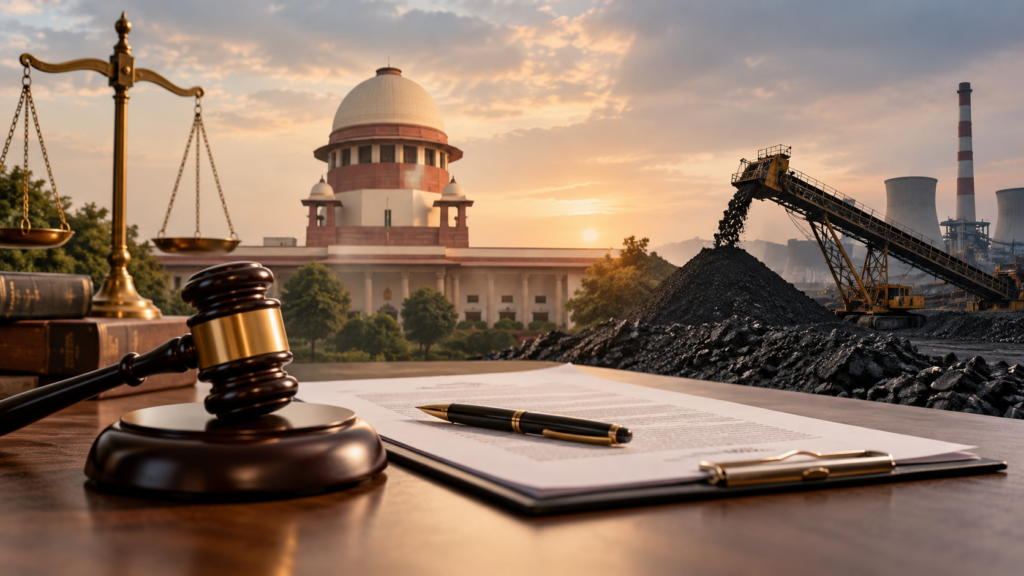
Supreme Court Appoints Justice Sanjay Kishan Kaul as Sole Arbitrator in Adani-RVUNL Coal Dispute
The Supreme Court has modified an order of the Rajasthan High Court concerning the appointment of a sole arbitrator in a commercial dispute between Parsa Kente Collieries Ltd. (PKCL) and Rajasthan Rajya Vidyut Utpadan Nigam Ltd. (RVUNL). The apex court has appointed former Supreme Court judge Justice Sanjay Kishan Kaul as the sole arbitrator, replacing former Supreme Court judge Justice Arun Mishra.
The decision came after the parties mutually agreed during the Supreme Court proceedings to have Justice Kaul adjudicate the dispute. Importantly, the Supreme Court clarified that the ground put forward for seeking a change of arbitrator was not legally sustainable. Therefore, the order should not be understood as a finding that Justice Arun Mishra was biased or legally ineligible to act as arbitrator.
The matter was heard by a three-judge Bench comprising Chief Justice of India Surya Kant, Justice Joymalya Bagchi and Justice V. Mohana. The case is titled Rajasthan Rajya Vidyut Utpadan Nigam Ltd. v. Parsa Kente Collieries Limited, Special Leave Petition (Civil) No. 25773 of 2026, and is reported as 2026 LLBiz SC 262.
Background of the Coal Dispute
The dispute originates from a long-term commercial arrangement concerning the mining and supply of coal from the Parsa East and Kanta Basan coal blocks.
Parsa Kente Collieries Ltd. is a joint venture in which Adani Enterprises Ltd. holds a 74% share, while RVUNL holds the remaining 26%. The joint venture was established for the development and operation of coal blocks and the supply of coal to RVUNL’s thermal power stations.
The parties entered into a Coal Mining and Delivery Agreement (CMDA) on 16 July 2008. The agreement established the contractual framework governing mining operations and the delivery of coal.
Over the course of the relationship, disputes arose between the parties concerning the coal mining and supply arrangement. These included claims relating to price adjustment and other contractual issues. The dispute subsequently moved into arbitration and, at various stages, came before the courts.
Rajasthan High Court’s Appointment of Justice Arun Mishra
The question of who would adjudicate the dispute came before the Rajasthan High Court in 2026.
On 3 July 2026, the Rajasthan High Court appointed former Supreme Court judge Justice Arun Mishra as the sole arbitrator. The High Court noted that an arbitrator had already been appointed in a similar dispute and proceeded to appoint Justice Mishra in the present arbitration application.
The order contemplated that the appointed arbitrator would determine the issues arising between the parties.
RVUNL, however, challenged the appointment before the Supreme Court. The challenge brought the question of the constitution of the arbitral tribunal before the apex court.
The dispute at this stage was therefore not about the final merits of the coal-related contractual claims. Instead, the immediate issue concerned the identity of the person who would serve as the sole arbitrator.
Supreme Court Examines the Challenge
The Supreme Court considered RVUNL’s request for a change of arbitrator on 3 August 2026.
RVUNL sought the replacement of Justice Arun Mishra. However, after examining the ground advanced for seeking the change, the Supreme Court did not find it legally sustainable.
This observation is one of the most significant aspects of the decision.
The Court did not state that Justice Mishra was biased. It also did not hold that he was legally disqualified from serving as arbitrator. Rather, the Court specifically recorded that the ground relied upon by the party seeking his replacement could not legally justify the requested change.
The subsequent change in arbitrator therefore cannot accurately be characterised as a judicial finding against Justice Mishra.
Parties Agree on Justice Sanjay Kishan Kaul
Despite the Court’s view that the ground for changing the arbitrator was not legally sustainable, the proceedings took a different course when the parties reached an agreement.
During the hearing, both sides mutually agreed that former Supreme Court judge Justice Sanjay Kishan Kaul should be appointed as the sole arbitrator.
The Supreme Court recorded this agreement and modified the Rajasthan High Court’s earlier order accordingly.
Justice Sanjay Kishan Kaul was therefore appointed as the sole arbitrator in place of Justice Arun Mishra.
This approach allowed the arbitration to proceed with an arbitrator acceptable to both parties while avoiding a prolonged dispute over the constitution of the arbitral tribunal.
Importance of Party Autonomy in Arbitration
The decision highlights an important feature of arbitration: the role of party autonomy.
Arbitration is based fundamentally on the agreement of the parties to submit their disputes to a private adjudicatory process. The ability of parties to participate in the selection of an arbitrator is an important part of that framework.
In commercial disputes, particularly those involving large infrastructure or energy projects, the choice of arbitrator can have significant procedural importance. Parties may prefer an arbitrator with substantial judicial or commercial experience and, where possible, may seek to reach consensus on the appointment.
The present case demonstrates how party agreement can ultimately resolve an issue concerning the constitution of an arbitral tribunal.
The Supreme Court did not accept the legal basis advanced for replacing Justice Mishra. However, once both parties agreed upon Justice Kaul, the Court gave effect to that consensus by modifying the High Court’s order.
Distinction Between Replacement and Disqualification
The decision also demonstrates why legal reporting of arbitration cases requires precision.
It would be incorrect to describe the Supreme Court’s order as a finding that Justice Arun Mishra was unfit to act as arbitrator.
The Court’s recorded position was that the ground urged for changing the arbitrator was not legally sustainable. The replacement occurred because the parties themselves agreed during the hearing to appoint Justice Sanjay Kishan Kaul.
This distinction is important because the replacement of an arbitrator can occur for several different reasons. It may result from a legally established disqualification, a successful challenge based on statutory grounds, procedural circumstances, or, as in this case, an agreement reached by the parties and recorded by the Court.
Accordingly, the present order should be understood in the context of the parties’ consent rather than as a judicial finding of bias or misconduct.
Broader Significance for Commercial Arbitration
The dispute is also significant because it arises from a major coal mining and supply arrangement.
Commercial contracts involving mining, energy and infrastructure often contain complex financial and operational obligations. Disputes may involve pricing mechanisms, supply commitments, costs, contractual adjustments and other issues that require detailed examination.
Arbitration can provide an efficient mechanism for resolving such disputes, particularly where the parties have agreed to refer contractual controversies to a neutral adjudicator.
At the same time, disputes concerning the appointment of arbitrators can themselves delay the substantive resolution of the underlying matter. The Supreme Court’s approach in the present case enables the parties to move forward with a mutually agreed sole arbitrator.
The appointment of Justice Kaul therefore brings clarity to the composition of the arbitral tribunal and allows attention to return to the substantive contractual dispute between PKCL and RVUNL.
The Underlying Dispute Continues
The Supreme Court’s order concerns the appointment of the arbitrator and does not finally determine the substantive claims arising from the Coal Mining and Delivery Agreement.
The underlying commercial issues between PKCL and RVUNL will therefore continue to be examined through the arbitral process.
Justice Sanjay Kishan Kaul, as the newly appointed sole arbitrator, will be responsible for adjudicating the issues falling within the scope of the arbitration.
The Supreme Court’s intervention has consequently dealt with the procedural question concerning the constitution of the arbitral tribunal rather than deciding the parties’ underlying contractual claims.
Conclusion
The Supreme Court’s decision in Rajasthan Rajya Vidyut Utpadan Nigam Ltd. v. Parsa Kente Collieries Limited provides an important illustration of how disputes concerning arbitral appointments can be resolved.
The Court modified the Rajasthan High Court’s 3 July 2026 order appointing Justice Arun Mishra as sole arbitrator and appointed Justice Sanjay Kishan Kaul instead. The change followed the mutual agreement of the parties during the Supreme Court hearing.
At the same time, the Court made an important legal clarification: it did not find the ground advanced for changing Justice Mishra to be legally sustainable. Consequently, the decision should not be interpreted as a finding of bias, misconduct or disqualification against the former judge.
The case highlights the importance of both legal grounds for challenging an arbitrator and party autonomy in arbitration. Where parties can reach consensus on the composition of an arbitral tribunal, such agreement can provide a practical route for ensuring that the substantive dispute proceeds without unnecessary procedural delay.
With Justice Sanjay Kishan Kaul now appointed as sole arbitrator, the focus can return to the underlying commercial dispute arising from the coal mining and supply arrangement between PKCL and RVUNL. The case will remain significant for the broader discussion surrounding arbitral appointments, party consent and the efficient resolution of complex commercial disputes in India.